Tackling the Hard Challenge of Small-Molecule Detection: Cloud-Clone Leads the Industry Through Independent Innovation
Over a Decade of Persistent R&D Breaks Technical Barriers for Small-Molecule ELISA Assays HUSTON, TX, UNITED STATES,
Press Release Disclaimer: This is a press release distributed through the XPR Media network. It has not been independently verified by our newsroom.

Over a Decade of Persistent R&D Breaks Technical Barriers for Small-Molecule ELISA Assays
HUSTON, TX, UNITED STATES, September 21, 2026 /EINPresswire.com/ — Small-molecule biomarker measurement represents one of the most persistent technical bottlenecks in modern biomedical research. Lacking intrinsic immunogenicity, small molecules with molecular weights below 1000 Da pose substantial obstacles to antibody generation and immunoassay development. For years, researchers worldwide have relied on cumbersome chromatographic instruments for such analyses. Through more than ten years of continuous technical exploration, Cloud-Clone has overcome core technical hurdles and built a mature portfolio of small-molecule ELISA kits, delivering high-performance research tools for the global scientific community.
In biomedical research, small-molecule substances present long-standing headaches for investigators. These molecules under 1000 daltons include functionally critical cellular metabolites such as glutathione and melatonin, clinically important hormones including estradiol and insulin, as well as prohibited screening analytes like clenbuterol for food-safety monitoring. Though biologically significant, their simple chemical structures make them difficult to capture, forming a long-recognized technical bottleneck for detection workflows. Cloud-Clone’s R&D team has spent over ten years tackling these challenges, paving a competitive technological path for biological reagent development.
Dilemma: Bottlenecks in Small-Molecule Detection Limit Conventional Solutions
Small-molecule analytes are structurally simple and lack intrinsic immunogenicity. Direct animal immunization fails to trigger specific immune responses, so target-specific antibodies cannot be obtained, rendering standard immunoassay approaches infeasible. Conventional mainstream detection approaches rely heavily on high-performance liquid chromatography and gas-chromatography-mass spectrometry platforms. These techniques demand high-cost precision instruments and rigorous sample pre-treatment. Individual assays take multiple hours to complete, placing heavy burdens on basic laboratories and frequently delaying research progress even in universities and research institutes.
“Where market demands and research pain points exist, we dare to explore.” Guided by this corporate vision, Cloud-Clone prioritized small-molecule ELISA kit development as a core strategic project. Its research team embarked on more than ten years of intensive technical exploration.
Breakthrough: Structural Modification Drives Progress via Hundreds of Iterative Assays
Triiodothyronine (T3) measurement is critical for monitoring hypothyroid patients under thyroxine-replacement therapy and carries high clinical and research value. While clinical T3 detection reagents are available, suitable research-grade kits for animal-model studies remain scarce. Cloud-Clone’s small-molecule team initially attempted classic carboxyl-amino coupling to conjugate T3 with carrier proteins for animal immunization. Repeated attempts yielded unsatisfactory outcomes: either native molecular structures were destroyed, or generated antibodies exhibited poor target specificity and could not support practical applications. Frequent failures did not deter the team, which redirected its strategic thinking.
Inspiration came from structural-optimization strategies applied in small-molecule immunomodulator research. Side-chain modification and non-natural-amino-acid introduction could preserve immunostimulatory activity while optimizing pharmacokinetic properties, offering a potential solution for insufficient immunogenicity caused by direct conjugation. The team shifted away from direct coupling and restarted development starting from raw-material chemical transformation.
After dissecting T3 molecular architecture and analyzing reactive-site properties, researchers noted that its carboxyl group sits adjacent to an amino group. A novel workflow was designed: esterification was applied to block the carboxyl group, followed by chemical modification with succinic anhydride to append succinic acid moieties and generate carboxylated hapten derivatives. Positive experimental results brought long-awaited breakthroughs for Cloud-Clone’s small-molecule research program.
This represents only one example of countless structural-optimization campaigns. The team completed hundreds of comparable modification trials for analytes ranging from malondialdehyde and estradiol to T3 and melatonin. Every modification underwent careful experimental design supported by solid datasets. Researchers refined molecular structures iteratively to identify optimal modification schemes for each target analyte.
Advancement: Building Robust Assay Systems Supported by Solid Performance Data
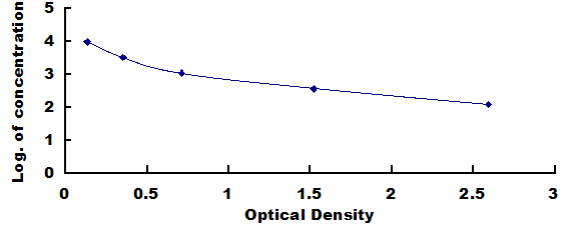
After resolving structural-modification challenges, new obstacles emerged in assay-system construction. Large-protein antigens can simultaneously bind two distinct antibodies for sandwich-format ELISA, yet small molecules are too compact for this format. Competitive-inhibition ELISA workflows were therefore adopted. Researchers invested long working hours iterating experimental parameters, screening optimal antigen-antibody pairs, and verifying system stability. Team members took shifts monitoring microplate-reader readouts. Well-defined standard curves were finally obtained, marking another major milestone and expanding Cloud-Clone’s small-molecule ELISA kit portfolio.
Figure 1. Standard curve of Cloud-Clone T3 ELISA kit
Recognition: Academic Citations Surpass International Peers as Independent-Developed Reagents Gain Global Traction
Ultimate validation for research-use products comes from broad academic citations. According to statistics from Google Scholar as of December 2025, Cloud-Clone’s small-molecule ELISA kits for key analytes including malondialdehyde, estradiol and testosterone have accumulated citation volumes comparable to or exceeding well-established international suppliers such as R&D and Abcam. These metrics confirm Cloud-Clone’s leading market position within the small-molecule-detection segment.
Increasing numbers of global investigators adopt Cloud-Clone kits as core research tools, with associated findings published across high-impact journals. Cloud-Clone holds ISO9001:2015 and ISO13485:2016 quality-management-system certifications and operates a licensed SPF-grade laboratory-animal facility. End-to-end in-house control from animal breeding to finished-reagent manufacturing underpins consistent product quality.
As global biomedical research continuously evolves, demand for reliable, cost-effective small-molecule-detection tools keeps rising. Moving forward, Cloud-Clone will deepen its commitment to biological-reagent innovation. By delivering high-quality research products, the company aims to empower global scientific discovery and further raise the global profile of independently developed biological research reagents.
About Cloud-Clone Corp.
Cloud-Clone Corp. is dedicated to the development and production of high-quality immunoassay reagents and detection solutions. With a focus on antibody engineering, multiplex assay development, and cross-platform compatibility, the company provides research tools designed to support precision medicine and advanced biomedical investigation globally. Our core products and services include the research and development of proteins, antibodies, ELISA kits, primary cells, and multiplex cytokine assay kits, as well as professional CRO services to fully meet the diverse needs of biomedical research and related fields.
For more information about Cloud-Clone Corp, visit www.cloud-clone.com.
CLOUD-CLONE CORP.(CCC)
Tel: 001-832-538-0970, 0086-27-8425-9552
Email: mail@cloud-clone.com, sales@cloud-clone.us
Visit us on social media:
LinkedIn: https://www.linkedin.com/company/cloud-clone-corp/
Instagram: https://www.instagram.com/cloudclonecorp2023/
TickTok: https://www.tiktok.com/@cloudclonecorp2026
SuKi Duan
CLOUD-CLONE CORP.WUHAN
email us here
Visit us on social media:
LinkedIn
Instagram
TikTok
X
Legal Disclaimer:
EIN Presswire provides this news content “as is” without warranty of any kind. We do not accept any responsibility or liability
for the accuracy, content, images, videos, licenses, completeness, legality, or reliability of the information contained in this
article. If you have any complaints or copyright issues related to this article, kindly contact the author above.

Media gallery