AI-guided design yields a fast halide solid electrolyte for long-life all-solid-state batteries
GA, UNITED STATES, November 26, 2026 /EINPresswire.com/ -- A data-driven workflow that combines large language models
Press Release Disclaimer: This is a press release distributed through the XPR Media network. It has not been independently verified by our newsroom.
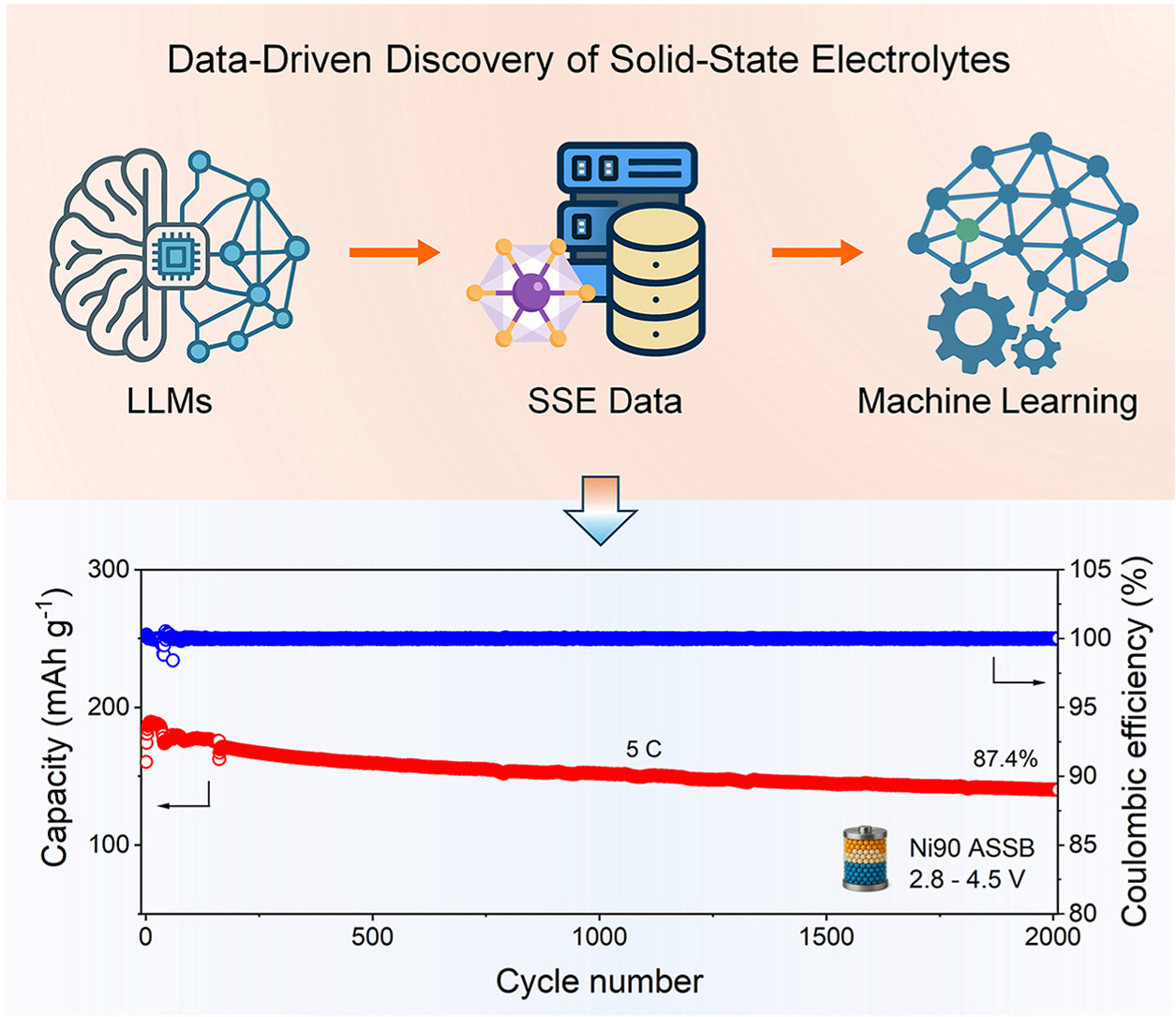

GA, UNITED STATES, November 26, 2026 /EINPresswire.com/ — A data-driven workflow that combines large language models (LLMs) and machine learning (ML) can turn scattered halide solid-state electrolyte (HSSE) literature into design rules and new materials. By mining reported HSSEs and learning structure–property relationships, researchers identified cationic potential, lithium content and cationic charge density as key features governing ionic conductivity. These features guided the discovery of LiTa₀.₉Al₀.₁O₀.₅Cl₄.₈ (LTAOC), a fast halide electrolyte that supports all-solid-state batteries (ASSBs) with long cycling stability and high areal capacity. The study shows how -assisted feature extraction can accelerate rational electrolyte design beyond trial and error and offers a practical route toward next-generation energy storage.
All-solid-state batteries promise high safety and energy density for next-generation storage. Halide solid-state electrolytes are attractive because they combine high ionic conductivity with high-voltage stability. Yet halide solid-state electrolyte (HSSE) discovery still relies heavily on empirical trial and error, which is time-consuming and resource-intensive and offers limited guidance for rational design. The structure–property–performance relationships that control ionic transport remain insufficiently understood, slowing development of new materials for high-energy all-solid-state batteries (ASSBs). High-quality datasets and predictive tools are also scarce, limiting the transition from laboratory results to practical electrolytes. Given these challenges, in-depth research is needed on data-driven, predictive discovery of halide solid-state electrolytes.
Researchers at Tianjin University, with collaborators at the Institute of Chemistry, Chinese Academy of Sciences, and the University of Chinese Academy of Sciences, published the study online in eScience on Nov. 2026. The team used large language models (LLMs) to build an HSSE dataset from published literature, applied machine learning (ML) to identify conductivity-governing features, and validated predictions by synthesizing LiTa₀.₉Al₀.₁O₀.₅Cl₄.₈ (LTAOC). This workflow connected text mining, feature analysis, materials synthesis and battery-level validation. The work reports a data-driven paradigm for electrolyte discovery and design.
The workflow extracted hundreds of HSSE records from more than 100 research articles, and the LLM-based extraction was checked for reliability before analysis. After duplicate reports were filtered, an ML regression model linked chemical features to ionic conductivity and highlighted cationic potential, lithium content and charge density. The model screened metal-doped Li–Ta–O–Cl compositions and identified Al as the most promising dopant. The predicted LTAOC delivered high ionic conductivity at room temperature and lower activation energy than undoped LiTaO₀.₅Cl₅ (LTOC). X-ray diffraction and electron microscopy confirmed an amorphous matrix, while spectroscopy and secondary ion mass spectrometry indicated Al–O–Cl and Ta–Al–O–Cl clusters, more Li–Cl coordination and fast Li⁺ transport along Cl-terminated pathways. In LiNi₀.₉Co₀.₀₅Mn₀.₀₅O₂ (Ni90) ASSBs, LTAOC supported long cycling and high-loading cells, linking the predicted feature rules to cell-level performance. Al doping increased structural disorder and shifted Li coordination toward Cl-rich environments. The amorphous structure, rather than a crystalline framework, appears central to the fast ion transport. The combined evidence supports a design picture in which Al incorporation raises charge density and disorder while creating more Cl-coordinated Li sites. The results show that the three features are not merely statistical descriptors; they can be tuned experimentally through dopant choice and composition.
The authors said the advance is less about one formula than about a repeatable discovery loop. They said LLMs can convert fragmented literature into structured data, while ML turns that data into testable chemical rules. In their view, combining cationic potential, lithium content and charge density gave a practical map for designing amorphous halide electrolytes, and the experimental LTAOC results confirmed that the map could guide real synthesis rather than only retrospective analysis. They said this loop can shorten the path from hypothesis to cell-level validation.
LTAOC’s combination of high ionic conductivity, low activation energy and long cycle life points to practical halide electrolytes for high-energy ASSBs, especially high-loading cells. The broader implication is a template for materials discovery: LLMs can curate domain datasets, ML can rank features and candidates, and experiments can close the loop. The approach could be extended to other solid electrolytes and inorganic materials where data are fragmented. Before deployment, researchers will need to assess scalability, cost, moisture stability, interfacial compatibility and manufacturing under realistic conditions. The study also highlights the need for standardized, high-quality databases and transparent model validation so data-driven predictions can be trusted across laboratories.
References
DOI
10.1016/j.esci.2026.100590
Original Source URL
https://doi.org/10.1016/j.esci.2026.100590
Funding information
National Natural Science Foundation of China (No. 22379108); Beijing National Laboratory for Molecular Sciences (No. BNLMS202404); Tianjin Natural Science Foundation Project (No. 24JCZXJC00100); Haihe Lab of Information Technology Application Innovation (No. 22HHXCJC00002); additional support from Haihe Laboratory of Sustainable Chemical Transformations, National Industry–Education Integration Platform of Energy Storage, and Fundamental Research Funds for Central Universities.
Lucy Wang
BioDesign Research
email us here
Legal Disclaimer:
EIN Presswire provides this news content “as is” without warranty of any kind. We do not accept any responsibility or liability
for the accuracy, content, images, videos, licenses, completeness, legality, or reliability of the information contained in this
article. If you have any complaints or copyright issues related to this article, kindly contact the author above.

Media gallery