Fiber Optic Connectors Market to Surpass $8 Billion by 2030 at 6% CAGR, LC Connectors Accounting for 37%
The Business Research Company’s Fiber Optic Connectors Global Market Report 2026 – Market Size, Trends, And Forecast
Press Release Disclaimer: This is a press release distributed through the XPR Media network. It has not been independently verified by our newsroom.

The Business Research Company’s Fiber Optic Connectors Global Market Report 2026 – Market Size, Trends, And Forecast 2026-2035
LONDON, GREATER LONDON, UNITED KINGDOM, October 8, 2026 /EINPresswire.com/ — The fiber optic connectors market is set to experience significant growth as digital technology and communication infrastructure continue to advance rapidly. This sector, a vital part of the broader communications hardware industry, is increasingly important for ensuring fast, efficient, and reliable data transmission across various networks. Below, we explore the current market status, key growth drivers, leading segments, regional insights, competitive dynamics, and future opportunities shaping this industry.
Projected Market Size and Growth Path for Fiber Optic Connectors
The fiber optic connectors market is forecasted to exceed $8 billion by 2030. It forms a small but crucial part of the Communications Hardware market, which is expected to reach nearly $1,026 billion by the same year, with connectors contributing about 1% of that total. Within the extensive Information Technology industry, projected at $13,788 billion by 2030, fiber optic connectors represent roughly 0.1% of the market’s overall value.
Request A Free Sample Of The Fiber Optic Connectors Market Report
https://thebusinessresearchcompany.com/sample_request?id=86638424&type=smp&name=Fiber%20Optic%20Connectors%20Market%20Report%202026&utm_source=EINPresswire&utm_medium=Paid&utm_campaign=Oct_PR
Primary Factors Fueling Fiber Optic Connectors Market Expansion
The dynamic growth of data centers is a major catalyst for the fiber optic connectors market. With the rise of cloud computing, AI, and digital services, there is heavy investment in advanced fiber infrastructure. Fiber optic connectors ensure low-loss, high-speed, and dependable connections between servers, storage, and networking equipment, making them essential to modern data center designs. This trend alone is expected to drive about 2.2% annual growth for the market.
Another significant driver is the widespread deployment of 5G and fiber broadband networks. The extensive fiber backhaul and fronthaul needed for 5G, along with expanding fiber-to-the-home (FTTH) initiatives, are boosting demand for reliable optical connectors across telecom infrastructures. This factor contributes an estimated 2.0% annual growth rate.
Access The Detailed Fiber Optic Connectors Market Report Here
https://thebusinessresearchcompany.com/report/fiber-optic-connectors-global-market-report?utm_source=EINPresswire&utm_medium=Paid&utm_campaign=Oct_PR
Demand for high-speed data transmission also plays a vital role. Fiber optic connectors offer higher bandwidth and lower signal loss compared to copper alternatives, supporting sectors such as healthcare, banking, manufacturing, transportation, and defense as they upgrade communication infrastructures. This driver contributes approximately 1.7% annual growth to the market.
Leading Product Segment in the Fiber Optic Connectors Market
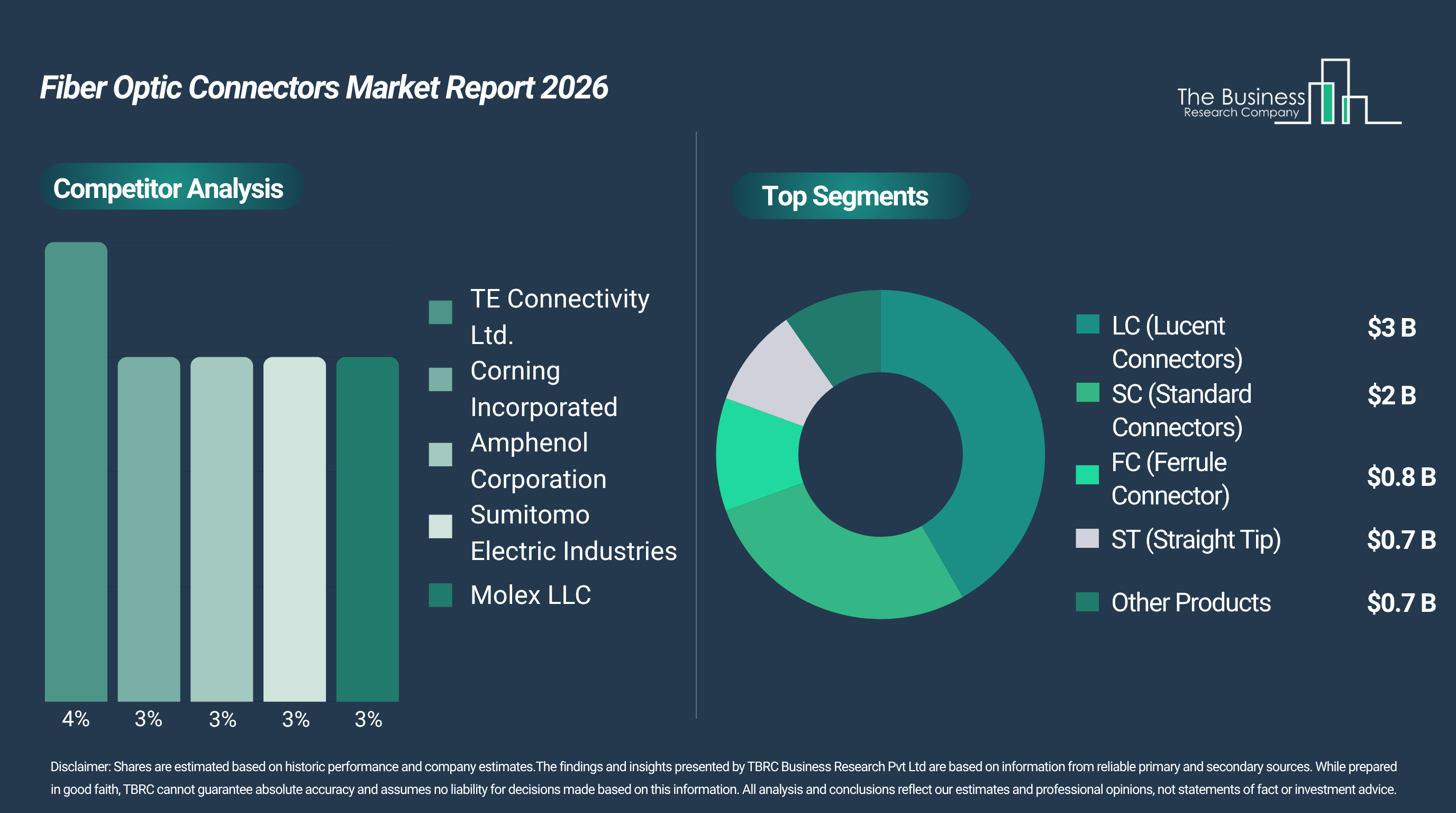
Among various product types—SC (standard connectors), LC (lucent connectors), FC (ferrule connector), ST (straight tip), MXC connector, and others—the LC segment will dominate in 2030. Expected to represent 37% of the market, or about $3 billion, LC connectors benefit from their compact design and high-density fiber connectivity. Their popularity is boosted by data center cable management needs, enterprise networking applications, and ongoing innovations that enhance signal quality and installation flexibility.
Additional Market Segments by Cable and Application
The fiber optic connectors market is further divided by cable type into simplex, duplex, and multi-fiber categories. Application-wise, it spans telecommunication, inter- or intra-building connections, community antenna television, data centers, high-density interconnection, security systems, and other areas.
Regional Focus on Asia Pacific as a Growth Hub
Asia Pacific is projected to be the largest regional market by 2030, with a valuation of $3.1 billion, growing from $2.3 billion in 2025 at a 6% CAGR. This robust expansion is driven by rapid broadband infrastructure development, increased fiber network investments in emerging economies, advances in next-gen telecommunications, and a rising need for dependable, high-bandwidth connectivity to support digital transformation initiatives.
United States Leads as the Largest National Market by 2030
The USA is forecasted to be the top country in the fiber optic connectors market in 2030, valued at $1.5 billion up from $1.2 billion in 2025, reflecting a 5% CAGR. Growth here is fueled by FTTH deployments, hyperscale data center investments, enterprise adoption of high-speed tech, and ongoing upgrades to telecom infrastructure to handle growing data traffic.
Companies Steering the Competitive Landscape
Global manufacturers specializing in optical networking equipment and connectivity solutions dominate this market. They prioritize high-performance connector designs, cutting-edge transmission technologies, miniaturization, and enhanced reliability tailored to telecommunications, data centers, and industrial sectors. As bandwidth demand surges and fiber optic networks expand, firms focus on innovation and strategic partnerships to maintain their market position.
TE Connectivity Ltd. stands out as the market leader in 2025 with a 4% share. Its communications solutions division offers a broad range of fiber optic connectivity products and high-speed interconnect solutions for telecom infrastructure, data centers, enterprise networks, and industrial communications.
Market Fragmentation and Key Players’ Impact
The fiber optic connectors market is moderately fragmented, with the top 10 players holding 23% of total revenue in 2025. Entry barriers arise from stringent performance expectations, high-precision manufacturing, compatibility requirements, and advanced engineering needs. Leading companies maintain strong market shares by offering diversified portfolios, solid partnerships with network providers, global distribution channels, and continuous technological innovation. As demand grows for high-speed data transmission and expanded fiber networks, collaborative efforts and regional growth strategies will be vital for competitive advantage.
The top companies and their market shares in 2025 include:
– TE Connectivity Ltd. (4%)
– Corning Incorporated (3%)
– Amphenol Corporation (3%)
– Sumitomo Electric Industries (3%)
– Molex LLC (3%)
– Furukawa Electric Co. Ltd. (3%)
– US Conec Ltd. (2%)
– AFL Telecommunications LLC (1%)
– HUBER+SUHNER AG (1%)
– The Siemon Company (0.1%)
Advancements Transforming Installation and Efficiency
Field-installable fiber optic connector systems are revolutionizing the market by reducing installation times and boosting deployment efficiency, which accelerates broadband infrastructure rollouts. For example, in May 2025, Corning Incorporated unveiled its Evolv Field Installable Pushlok connector system. This product simplifies fiber terminations without fusion splicing, supports hardened subscriber drop cables, and requires fewer tools, enhancing operational effectiveness particularly in rural or hard-to-access locations.
Market Growth Prospects to 2030 Across Product Categories
All six product segments are expected to contribute significantly to market growth, adding more than $2.7 billion by 2030. Between 2025 and 2030, SC and LC connectors are each forecasted to grow by $1 billion, with FC and ST connectors adding $0.2 billion each, MXC connectors $0.1 billion, and other products $0.2 billion. This expansion is driven by fiber broadband rollouts, hyperscale data center investments, 5G and FTTH infrastructure developments, and the ongoing need for low-loss, high-density connectivity as telecommunications networks evolve.
Strategies for Maintaining Competitive Edge in the Market
Key competitive tactics include advancing fiber optic connector technologies to enhance data transmission, optimizing connector designs for faster and more reliable installation, expanding fiber infrastructure to support broadband and data networks, and adopting cutting-edge manufacturing methods to boost precision and production efficiency.
Notable Players Driving the Fiber Optic Connectors Industry
Some of the prominent companies competing in this space are TE Connectivity Ltd., Corning Incorporated, Amphenol Corporation, Sumitomo Electric Industries, Molex LLC, Furukawa Electric Co. Ltd., US Conec Ltd., AFL Telecommunications LLC, HUBER+SUHNER AG, The Siemon Company, Phoenix Contact GmbH & Co. KG, SENKO Advanced Components, Broadcom Inc., Panduit Corporation, Samtec, Inc., 3M Company, Radiall SA, Rosenberger Group, OFS Fitel LLC, Hirose Electric Co. Ltd., Diamond SA, and L-com Global Connectivity.
Supply Chain and Customer Network Overview
Raw materials for fiber optic connectors are supplied by companies including Corning Incorporated, Sumitomo Electric Industries Ltd., Prysmian Group, Furukawa Electric Co., Ltd., and others. Distributors and wholesalers such as Digi-Key Electronics, Mouser Electronics, Arrow Electronics, Avnet, RS Group, and Ingram Micro serve as important intermediaries. End users encompass major corporations in technology and telecommunications, including Cisco Systems, Nokia, Ericsson, Huawei, ZTE, Ciena, Juniper Networks, Arista Networks, CommScope, ADTRAN, Broadcom, Dell Technologies, Hewlett Packard Enterprise, IBM, Oracle, Microsoft, Amazon Web Services, Google, Verizon, AT&T, Deutsche Telekom, NTT Communications, Lumen Technologies, Orange, and Vodafone.
What’s new in our 2026 market reports:
• Market attractiveness scoring and analysis
• Total addressable market (TAM) analysis
• Company scoring matrix graphics and tables
• Excel dashboards
• Market hotspots infographics
• Key technologies and future trends
• Updated graphics and tables
About The Business Research Company
The Business Research Company (www.thebusinessresearchcompany.com) is a renowned market intelligence firm specializing in company, market, and consumer research. With over 30,000+ reports spanning 27 industries and more than 60 geographies, their insights draw upon 1.5 million datasets, extensive secondary research, and interviews with industry leaders. They offer a range of tailored research packages such as Market Entry, Competitor Tracking, and Supplier & Distributor packages.
Disclaimer: The information provided by TBRC Business Research Pvt Ltd is gathered in good faith from primary and secondary sources, though accuracy cannot be fully guaranteed. The company disclaims liability for any actions taken based on its findings, which are intended as estimates and opinions rather than definitive facts or investment advice.
Contact Information
The Business Research Company
Americas: +1 310-496-7795
Europe: +44 7882 955267
Asia & Others: +44 7882 955267 / +91 8897263534
Email: marketing@tbrc.info
Follow on LinkedIn: https://in.linkedin.com/company/the-business-research-company
Oliver Guirdham
The Business Research Company
+44 7882 955267
Visit us on social media:
LinkedIn
Facebook
X
Legal Disclaimer:
EIN Presswire provides this news content “as is” without warranty of any kind. We do not accept any responsibility or liability
for the accuracy, content, images, videos, licenses, completeness, legality, or reliability of the information contained in this
article. If you have any complaints or copyright issues related to this article, kindly contact the author above.

Media gallery